
 Products
 Bars
Bars
 Beads & Spheres
 Bolts & Nuts
 Crucibles
 Discs
Discs
 Fibers & Fabrics
 Films
Films
 Flake
Flake
 Foams
Foams
 Foil
Foil
 Granules
 Honeycombs
 Ink
Ink
 Laminate
 Lumps
Lumps
 Meshes
 Metallised Film
 Plate
Plate
 Powders
 Rod
Rod
 Sheets
 Single Crystals
 Sputtering Target
 Tubes
Tubes
 Washer
 Wires
Wires
 Converters & Calculators
 Write for Us



Lab-Grown vs Natural Diamonds: Key Differences
Introduction
In the past few years, lab-grown diamonds have become extremely popular in the jewelry and industrial sectors. They are becoming more and more favored by individuals because of their beauty, ethical appeal, and affordability. And yet, natural diamonds hold a certain place in the heart of many people. This article attempts to bring out the differences between natural and lab-created diamonds. The attempt is to inform readers about the huge differences so that they can make informed choices based on their needs.
1. Origin and Formation
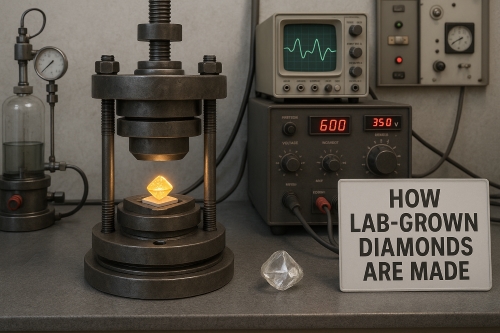
Natural diamonds are formed deep in the Earth under the extremes of pressure and heat. They form over billions of years and slowly find their way onto the Earth's surface. They are compared to man-made diamonds, as they are formed in a laboratory using known processes. The two leading processes are known as High Pressure High Temperature and Chemical Vapor Deposition. Both of these processes can produce a diamond in weeks to months. Whereas natural diamonds have an historical past, stones grown in the laboratory are produced using contemporary technology that is aimed at efficiency and accuracy.
2. Physical and Chemical Properties
Lab-grown and natural diamonds consist of all carbon. They have the same crystal formation, so they also exhibit comparable hardness and longevity. Basically, both can withstand scratches and the use and abuse of daily life with the same degree of success.
There tends to be a significant difference in the internal characteristics. Cult diamonds tend to have fewer blemishes because the growth conditions can be tightly controlled. Natural diamonds may have typical geological imperfections. Even collectors regard such imperfections as the natural fingerprint of a stone that has passed through the ages. In laboratory tests, both types show outstanding hardness and similar performance, rendering them equally suitable for a range of applications from jewelry to precision instruments.
3. Appearance and Quality
Both types of diamonds are well-known for their brilliance. When it comes to color, lab-grown diamonds are more versatile. Manufacturers can produce stones that are completely colorless or even manipulate slight shades at will. Natural diamonds develop their colors naturally while growing, often with small, natural flaws.
The cut and clarity grade is generally the same. Lab diamonds are capable of providing an equal quality level. They have a standard formation process, which results in even clarity grades. Natural diamonds have a charming uniqueness because each one of them is a product of ancient geological processes. Both are treated with care in luxury jewelry so that they appear dazzling in conditions like fashion jewelry and engagement rings.
4. Ethical and Environmental Implication
The ethical aspect of diamond production has become an important consideration for the majority of buyers. Traditional natural diamond extraction has been known to include land disruption, use of equipment, and environmental pollution in some instances. Local community impact and terms of employment have also become issues of concern in different places. For this reason, some consumers have turned to alternatives with good ethical standards.
Lab-grown diamonds offer a newer option. They are cultivated in laboratory settings that use less and cause less damage to the environment. The processes employed reduce water use, land displacement, and overall carbon emissions. For the consumer who values sustainability and conflict-free origins, lab-grown diamonds come as a relief from conventionally sourced gems.
5. Cost and Market Trends
Price is a key factor in the diamond industry. Lab diamonds are priced anywhere from 20 to 40 percent lower than natural diamonds. This cost savings does not necessarily need to come at the cost of quality and longevity. Many consumers find that a lab diamond offers an excellent relationship between beauty and cost.
Market trends reflect a growing acceptance of lab-grown diamonds, especially in pieces of jewelry. Individuals are embracing these stones for everyday wear and high-end designs. In industrial uses, the consistency and guaranteed quality of lab-grown diamonds have also attracted the attention of many professionals. Natural diamonds retain their value, particularly in the high-end resale segments, because of their inherent limitation and history.
6. Identification and Certification
Assuring the presence of any diamond is a part of the buying process. Gemologists make use of advanced instruments such as spectrometers to study the growth pattern of a diamond as well as internal markers. These instruments enable the permanent identification of man-made diamonds and natural diamonds.
Certification reports from established institutions are helpful. They indicate the color, clarity, cut, and carat weight of the diamond. To consumers, they are an assurance of quality control that the diamond meets industry standards. Certification plays an important role in the modern diamond market, as it guarantees that every stone's provenance and quality has been thoroughly checked. For more comparison, please check Stanford Advanced Materials (SAM).
Conclusion
Synthetic diamonds provide almost the same type of beauty and performance as natural diamonds. They are chemically and physically indistinguishable. Both glitter with fire, although lab-grown stones might yield more consistent quality due to controlled environments. The choice between a natural and a man-made diamond sometimes comes down to what one values. Cost, ethics, and personal taste are considerations in the choice. Whether you value the ancient past behind a natural diamond or the fresh promise of created stones, either is offered with breathtaking beauty and long-lasting performance.
Frequently Asked Questions
F: Why are lab-created diamonds less expensive than natural diamonds?
Q: Lab-created diamonds are less expensive because manufacturing is carried out in controlled processes and requires fewer resources.
F: How do you separate lab-created diamonds from natural diamonds?
Q: Advanced spectroscopy and certification depict growth patterns unique to lab-grown diamonds.
F: Are lab-grown diamonds as durable as natural diamonds?
Q: They are both made up of the same structure of carbon, with the same hardness and durability.
 Chin Trento