
 Products
 Bars
Bars
 Beads & Spheres
 Bolts & Nuts
 Crucibles
 Discs
Discs
 Fibers & Fabrics
 Films
Films
 Flake
Flake
 Foams
Foams
 Foil
Foil
 Granules
 Honeycombs
 Ink
Ink
 Laminate
 Lumps
Lumps
 Meshes
 Metallised Film
 Plate
Plate
 Powders
 Rod
Rod
 Sheets
 Single Crystals
 Sputtering Target
 Tubes
Tubes
 Washer
 Wires
Wires
 Converters & Calculators
 Write for Us



Industrial Uses of Lab-Grown Diamonds: Beyond Jewelry
Introduction
Lab-created diamonds have come a long way from their initial reputation as gemstone substitutes. Today, they offer performance and reliability that, in certain instances, cannot be matched by traditional materials. Lab-created diamonds are finding use in industry in many applications.
Mechanical Applications
Lab-created diamonds find excellent use in mechanical applications. Hardness and durability of the diamonds rank as the most significant advantages in a wide range of tools and components.
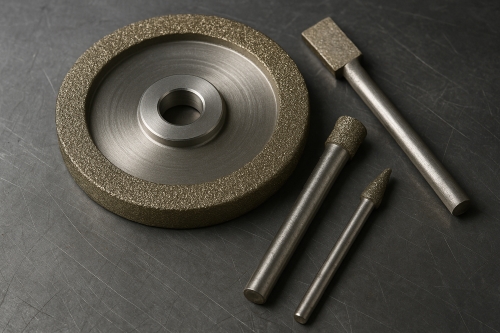
Cutting, Grinding, and Drilling Tools
• Synthetic diamonds find application in diamond-tipped saws, drills, and abrasives.
• They are used to machine hard materials such as stone, ceramics, and metals.
• An example is Chemical Vapor Deposition (CVD) diamond coatings. They provide improved wear resistance when machining carbide and composite materials.
Mechanical machining requires materials possessing the capability of maintaining a sharp edge and wear resistance. Tools last longer and perform more reliably with laboratory-grown diamonds. There is less downtime and fewer replacements are required in manufacturing and construction industries because of the durability of these diamonds.
High-Precision Machining
High-precision machining requires extremely accurate tools that possess the ability to create very smooth surfaces.
• Single-crystal diamond tools are utilized in the machining of optics and semiconductor wafers.
• Manufacturers have achieved surface finishes with sub-nanometer roughness. This kind of extreme precision is vital for components in the electronics industry and high-end optics.
When machining delicate materials, even minor defects matter. The precision that lab-grown diamond tools provide them with makes them a preferred option in environments where precision is paramount.
Wear-Resistant Components
The benefits of lab-grown diamonds extend to various components that find use in abrasive conditions.
• They find application as diamond bearings, seals, and valve components.
• These components enjoy extended lifetimes and stable performance under high-load or chemical conditions.
With their excellent resistance to wear, synthetic diamond components reduce the need for maintenance and increase the long-term reliability of equipment. This kind of reliability is especially important in heavy industry and chemical processing.
Further reading: Lab-Grown vs Natural Diamonds: Key Differences
Thermal Management Applications
Effectively managing heat is one of the greatest challenges to modern electronics and mechanical systems. Synthetic diamonds possess outstanding thermal characteristics.
Heat Spreaders in Electronics
Synthetic diamonds spread heat very well.
• They have a thermal conductivity of over 2000 watts per meter kelvin. That is approximately five times that of copper.
• They are used to manage heat in high-power gallium nitride and silicon carbide transistors. They also cool radar modules and laser diodes.
Electronics generate plenty of heat, and managing the heat is required for both performance and safety. Diamond-based heat spreaders avoid overheating and allow stable operation in advanced devices.
Diamond-on-Copper or Diamond-on-Silicon Composites
Composite materials bring together the finest attributes of different materials.
• Diamond-on-copper or diamond-on-silicon composites are recent advances in microelectronics packaging.
• They are seeing use in the latest wireless communication systems and electric vehicle power systems.
With the use of diamond composites, manufacturers can create components that not only spread heat well but also fit easily into the small form factors of new electronics.
Optical and Photonic Applications
Synthetic diamonds are used in optical applications due to their wide spectral transparency and robust nature.
Infrared and Ultraviolet Optics
Synthetic diamonds work well with a number of different wavelengths of light.
• They are transparent across a wide spectral range from 225 nanometers to 50 micrometers.
• This transparency renders them appropriate for application in high-power carbon dioxide laser windows, optical domes, and spectroscopic instruments.
The purity of cultured diamonds also makes them suitable for various optical devices. They are utilized to create strong, long-lasting windows and protective coatings even in environments with high energy.
Radiation Windows and Sensors
Radiation has a tendency to degrade conventional materials.
• Lab-created diamonds have high resistance to radiation.
• Their transparency also makes them ideal for X-ray and particle detectors in scientific research.
Diamonds are resistant to damage under high radiation environments. Due to this, they are a material of choice for application in advanced scientific equipment and sensors.
Electronics and Semiconductor Applications
Synthetic diamonds are finding increasing importance in electronics due to their high electrical properties.
Diamond as a Wide-Bandgap Semiconductor
Synthetic diamonds are semiconductors with high quality.
• They have a bandgap of 5.47 electron volts. This allows them to withstand extreme voltage and temperature environments.
• This attribute makes them potential replacements for silicon carbide and gallium nitride in next-generation power electronics.
Wide-bandgap semiconductors are essential for devices that operate under extreme conditions. Thanks to lab-grown diamonds, engineers can make devices that are more powerful and efficient.
Diamond-Based Transistors and Diodes
Synthetic diamonds have shown promise in terms of building new electronic devices.
• Field-effect transistors and Schottky diodes prototype developed using diamond have shown improved performance.
• They work well under high temperature and high voltage conditions, with durability and stability.
These devices create possibilities for electronic devices tomorrow that are more durable and higher performing even in extreme conditions.
Quantum Technologies
Synthetic diamonds find application in the field of quantum technology.
• Nitrogen-vacancy centers in diamonds are quantum bits for sensing and computing.
• They enable room-temperature quantum sensors with nanometer precision.
Diamond quantum sensors are already showing their worth for precision measurement and imaging. They may eventually transform computing and high-resolution detection.
Scientific and High-Pressure Research
Laboratory experiments often require materials that can withstand extreme conditions.
• Synthetic diamonds are used as anvils in diamond anvil cells. The method creates pressure exceeding 300 gigapascals.
• Synthetic diamonds are appreciated for consistency and purity. They maintain performance under extreme optical and mechanical stress.
These characteristics make lab-created diamonds precious when studying material behavior under pressures found in Earth's deepest depths.
Emerging Applications
New domains are finding new uses of lab-grown diamonds in both common and advanced technologies.
Biomedical Devices
Lab-grown diamond biocompatibility holds the future of advances in medicine.
• They are used as coatings for implants and surgical tools.
• Diamond electrodes are being developed for use in neural interfaces and biosensors.
Their wear and corrosion resistance make them suitable for use inside the human body and for medical implants that will remain for long durations.
Aerospace and Defense
High-speed flight and advanced guidance systems benefit from diamond technology.
• Synthetic diamonds are used as windows in high-speed flight.
• They provide durability and optical clarity even under vibrational stress and extremity conditions.
These attributes make lab-created diamonds a strategic material in aerospace solutions, where performance and reliability are critical.
Energy and Environmental Technologies
Lab-created diamonds are also used in energy and environmental solutions.
• Electrochemical diamond electrodes help in water purification.
• They help in pollutant degradation processes in environmental remediation technologies.
Their chemical inertness and usefulness in electrochemical reactions offer tremendous benefit to energy conversion and environmental remediation applications.
Economic and Market Outlook
The market for industrial diamonds continues to grow.
• Projections suggest that the size of the industrial diamond market will exceed 3.5 billion dollars by 2030.
• Synthetic diamonds may account for over 95 percent of production in this market.
• Some of the large producers include Element Six, Sumitomo Electric, and IIa Technologies.
• Quantum sensing and thermal management industries are expected to see rapid growth.
This positive market projection strengthens many industries' belief in the benefits that can be harvested from diamonds grown in a laboratory.
Conclusion
Lab-grown diamonds are much more than a substitute for jewelry. They have the ability to improve mechanical devices, prolong electronics, improve optical devices, and contribute to high-pressure research and novel applications. Their stability, thermal conductivity, and optical purity are unparalleled. The hardness and versatility of cultured diamonds lead industries to incorporate them into everyday technology, with the potential to deliver safer, longer-lasting, and more efficient solutions. Their growing role in applications such as biomedical implants, aerospace, and environmental technologies signals a bright future for these synthetic gems.
Frequently Asked Questions
Q: Why are lab-created diamonds suitable for mechanical tools?
A: Their hardness and wear resistance ensure long-term performance in cutting, grinding, and drilling.
Q: In what ways do diamonds help deal with heat in electronics?
A: They offer excellent thermal conductivity, dissipating heat in high-power transistors and other devices.
Q: Why are diamonds being used for high-precision machining and semiconductor equipment?
A: They create extremely smooth surfaces and are stable under critical machining and electronic procedures.
 Chin Trento