
 Products
 Bars
Bars
 Beads & Spheres
 Bolts & Nuts
 Crucibles
 Discs
Discs
 Fibers & Fabrics
 Films
Films
 Flake
Flake
 Foams
Foams
 Foil
Foil
 Granules
 Honeycombs
 Ink
Ink
 Laminate
 Lumps
Lumps
 Meshes
 Metallised Film
 Plate
Plate
 Powders
 Rod
Rod
 Sheets
 Single Crystals
 Sputtering Target
 Tubes
Tubes
 Washer
 Wires
Wires
 Converters & Calculators
 Write for Us



How Lab-Grown Diamonds Are Made: HPHT vs CVD Methods
Introduction
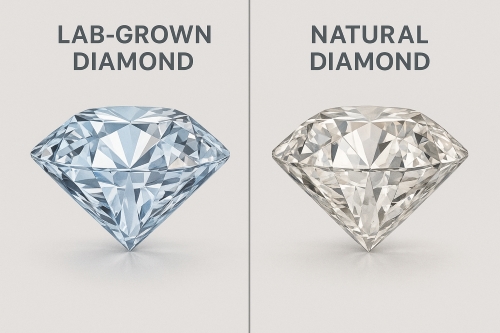
Lab-grown diamonds are a modern alternative for mined diamonds. They have the same chemical makeup as natural diamonds. They are grown in controlled conditions. We will explain the two main processes that create the lab-grown diamonds.
What Are Lab-Grown Diamonds?
Lab diamonds are crystals that are grown in the laboratory rather than in the earth. They are built from pure carbon. They possess the sp³ bonding and cubic crystal structure shared by natural diamonds. They are chemically the same. They are essentially the same in brilliance and hardness in most cases.
Principal advantages of these diamonds are ethical procurement since there is no mining. The environmental effect is negligible, and costs are cheaper than those of mined diamonds. They offer good quality control over what the final product will be. It is for this reason that they are both preferred in jewelry as well as industrial applications.
Overview of Diamond Growth Techniques
The synthesis history of diamonds is as old as the 1950s. Initial experiments were performed to determine whether diamonds can be formed outside nature. The current era boasts two established processes.
The first method is the High Pressure and High Temperature process. It imitates the natural process deep within the Earth where diamonds are formed over a period of millions of years. The second method is Chemical Vapor Deposition. It builds the diamond atom by atom and offers precise control over the growth process.
Both processes have improved with time. Both have their conditions and gear. Both can be utilized for different applications. Let us learn about the features and benefits of both processes.
The High Pressure and High Temperature Method
Principle of High Pressure and High Temperature Growth
The process relies on the fact that diamond formation does include very stringent conditions. It utilizes pressures ranging from 5 to 6 gigapascals. The temperature is maintained near 1500 to 1600°C. The conditions facilitate graphite's transformation into diamond. The transformation is supported with these extreme conditions. This process resembles nature's process but under a very short period of time.
Equipment and Setup
There is a need for special equipment in this process. Press systems vary. Cubic press, belt press, and split-sphere (or BARS press) systems are common. High pressure and temperature can be managed in these machines. These machines give a controlled system to the growth process.
Process Steps
The method starts with a small diamond seed. A source of carbon is added and subjected to extreme conditions. A molten metal catalyst, iron, nickel, or cobalt, is brought in. The catalyst helps carbon atoms arrange into a diamond shape. The growth is very slow. The diamond crystal builds outward from the seed over time. The process can take hours or even days, depending on the size and quality.
Typical Characteristics
Diamonds formed in this process may display a weak yellowish tint. The cause of this yellowish tint is the introduction of nitrogen while the growth is taking place. They also exhibit distinct inclusion patterns and visible growth zones. Industrial grade as well as gem-grade diamonds may be produced. Most uses of these diamonds in industry are present due to the fact that their physical characteristics are suitable for operations like cutting, drilling, and grinding.
The Chemical Vapor Deposition Process
Principle of Chemical Vapor Deposition Growth
The Chemical Vapor Deposition process is unique. It starts from a blend of hydrocarbon gases such as hydrogen and methane. A carbon plasma is produced in a gas phase inside a vacuum chamber. The atoms drop on a substrate and build the diamond layer by layer. This process gives scientists greater control over the purity and structure of the resultant diamond.
Process Steps
In this method, the first step involves the preparation of a clean substrate. The substrate typically contains a minute diamond seed. The process then takes place in a vacuum chamber. A microwave plasma or hot filament is used for hydrocarbon gas dissociation. The carbon atoms are emitted and then deposit themselves onto the substrate. The rate of growth, chamber temperature, and the ratios of gases are carefully controlled. This precise stacking facilitates the formation of highly uniform layers of diamonds, frequently containing less metallic inclusions.
Resulting Diamond Quality
The Chemical Vapor Deposition method is likely to yield very pure diamonds. They are mostly colorless and called Type IIa diamonds. These diamonds have very uniform internal structures. The method mostly yields fewer defects compared to the High Pressure and High Temperature method. Since they are very transparent and have controlled properties, they are ideal for high-quality jewelry. Semiconductors utilize these quality diamonds in numerous applications too.
Conclusion
Lab diamonds are the result of advanced technology and decades of research. The High Pressure and High Temperature method replicates nature. It uses intense pressure and heat with a catalyst to convert graphite to diamond. The Chemical Vapor Deposition method constructs the diamond atom by atom in a lab. Both methods have their pros and cons. For more information, please check Stanford Advanced Materials (SAM).
Frequently Asked Questions
Q: What is the biggest difference between natural diamonds and lab-grown diamonds?
A: Lab-grown diamonds are produced in laboratories, while natural diamonds are formed in the ground.
Q: Why would somebody choose the High Pressure and High Temperature process?
A: Because it is a very close simulation of natural methods and creates diamonds that are uniquely formed.
Q: How does the Chemical Vapor Deposition process ensure quality diamonds?
A: It builds up diamonds atom by atom under strict control for even growth.
 Chin Trento