
 Products
 Bars
Bars
 Beads & Spheres
 Bolts & Nuts
 Crucibles
 Discs
Discs
 Fibers & Fabrics
 Films
Films
 Flake
Flake
 Foams
Foams
 Foil
Foil
 Granules
 Honeycombs
 Ink
Ink
 Laminate
 Lumps
Lumps
 Meshes
 Metallised Film
 Plate
Plate
 Powders
 Rod
Rod
 Sheets
 Single Crystals
 Sputtering Target
 Tubes
Tubes
 Washer
 Wires
Wires
 Converters & Calculators
 Write for Us



PH Scale: Acids, Bases, and Common Materials
What is the pH Scale?
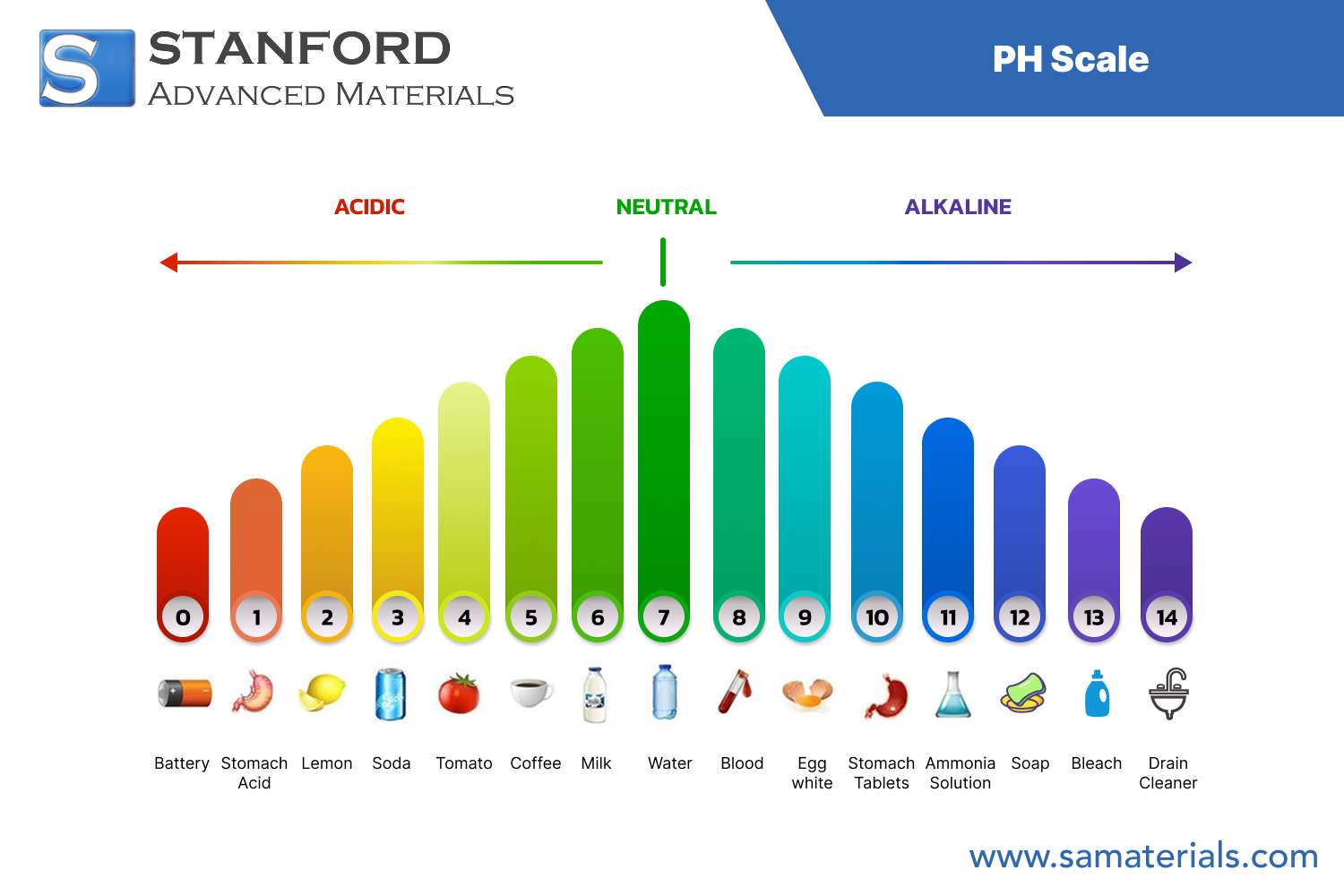
The pH scale measures how acidic or basic (alkaline) a substance is. It ranges from 0 to 14. A pH of 7 is neutral. Values below 7 are acidic, and values above 7 are basic. Pure water has a neutral pH of 7.
When substances dissolve in water, they can shift the pH. For example, vinegar and lemon juice are acidic, while substances like ammonia and laundry detergent are basic. Just like hot and cold describe temperature, acidic and basic describe chemical properties.
How is pH Measured?
PH is measured using a pH meter or pH paper. The meter uses a glass electrode to detect the concentration of hydrogen ions in a solution. PH paper contains indicators that change color based on the acidity or alkalinity of the substance it contacts.
pH Scale of Common Acids and Bases
All pH values are measured in aqueous solutions at a concentration of 10 mM.
Strong Acids
Complete dissociation in water (pKa < –1)
| Acid Name | Formula | Approx. pH (10 mM) |
|---|---|---|
| Hydrochloric acid | HCl | 2.04 |
| Nitric acid | HNO₃ | 2.04 |
| Hydrobromic acid | HBr | 2.04 |
| Hydroiodic acid | HI | 2.04 |
| Sulfuric acid¹ | H₂SO₄ | 1.87 |
| Perchloric acid² | HClO₄ | ~1.6 |
| Selenic acid | H₂SeO₄ | 1.83 |
Weak Acids
Partial dissociation in water (pKa > 3)
| Acid Name | Formula | Approx. pH (10 mM) |
|---|---|---|
| Orthophosphoric acid | H₃PO₄ | 2.26 |
| Arsenic acid | H₃AsO₄ | 2.31 |
| Selenous acid | H₂SeO₃ | 2.47 |
| Hydrofluoric acid | HF | 2.65 |
| Nitrous acid | HNO₂ | 2.67 |
| Molybdic acid | H₂MoO₄ | 2.94 |
| Hydrogen selenide | H₂Se | 2.93 |
| Carbonic acid | H₂CO₃ | 4.18 |
| Hydrogen sulfide | H₂S | 4.47 |
| Arsenious acid | H₃AsO₃ | 5.58 |
| Boric acid | H₃BO₃ | 5.62 |
| Silicic acid | H₄SiO₄ | 5.91 |
Strong Bases
Complete dissociation in water (high solubility, Kb large)
| Base Name | Formula | Approx. pH (10 mM) |
|---|---|---|
| Sodium hydroxide | NaOH | 11.95 |
| Potassium hydroxide | KOH | 11.95 |
| Barium hydroxide | Ba(OH)₂ | 12.22 |
| Calcium hydroxide | Ca(OH)₂ | 12.20 |
Weak Bases
Partial dissociation or low solubility (Kb small or insoluble)
| Base Name | Formula | Approx. pH (10 mM) | Notes |
|---|---|---|---|
| Ammonium hydroxide | NH₄OH | 10.61 | Actually NH₃•H₂O |
| Magnesium hydroxide* | Mg(OH)₂ | 10.40 | Saturated solution |
| Iron(II) hydroxide* | Fe(OH)₂ | 9.45 | Saturated solution |
| Sodium carbonate | Na₂CO₃ | 10.97 | Basic salt |
| Trisodium phosphate | Na₃PO₄ | ~12.10 | Strongly basic salt |
| Sodium metasilicate | Na₂SiO₃ | 11.91 | Alkaline silicate |
| Zinc hydroxide* | Zn(OH)₂ | 8.88 | Sparingly soluble |
| Nickel(II) hydroxide* | Ni(OH)₂ | 8.37 | Sparingly soluble |
| Cobalt(II) hydroxide* | Co(OH)₂ | 9.15 | Sparingly soluble |
| Chromium(III) hydroxide* | Cr(OH)₃ | 7.04 | Sparingly soluble |
| Beryllium hydroxide* | Be(OH)₂ | 7.90 | Amphoteric |
| Copper(II) hydroxide* | Cu(OH)₂ | 7.69 | Sparingly soluble |
| Sodium borate (borax) | Na₂B₄O₇ | 9.17 | Weak base via hydrolysis |
| Sodium bicarbonate | NaHCO₃ | 8.22 | Weakly basic salt |
| Potassium bicarbonate | KHCO₃ | 8.25 | Weakly basic salt |
Notes for Readers or Users
- Strong vs. weak is defined by extent of dissociation, not pH alone.
- pH values vary with temperature and ionic strength.
- This table assumes a temperature of 25°C, a dilute aqueous solution, and a nominal concentration of 10 mM, unless otherwise stated.
PH Scale of Common Materials
pH 0 – Extremely acidic
-
Battery acid (sulfuric acid) – highly corrosive, industrial use
pH 1 – Very strong acid
-
Stomach acid (hydrochloric acid) – essential for digestion
-
Industrial acid solutions
pH 2
-
Lemon juice – natural fruit acid
-
Vinegar (acetic acid) – used in cooking and cleaning
-
Cola and sports drinks – acidic due to phosphoric acid
pH 3
-
Orange juice – citrus-based acid
-
Soda and carbonated beverages
-
Pickled foods
pH 4
-
Tomatoes and tomato juice
-
Acid rain – environmental concern, often around pH 4.0–4.5
-
Apples and grapes
pH 5
-
Black coffee – slightly acidic due to organic acids
-
Bananas
-
Bread
pH 6
-
Urine – varies depending on hydration and diet
-
Milk – close to neutral but slightly acidic
-
Saliva (resting state)
pH 7 – Neutral
-
Distilled water – baseline for neutrality
-
Human blood (technically ~7.4 but considered close to neutral for reference)
pH 8
-
Sea water – slightly basic due to dissolved minerals
-
Eggs (especially egg whites)
-
Baking powder (mildly basic when dissolved)
pH 9
-
Baking soda (sodium bicarbonate) – common antacid
-
Toothpaste (some types)
-
Hand soap (mild base)
pH 10
-
Milk of magnesia (magnesium hydroxide) – used to relieve indigestion
-
Great Salt Lake water – mineral-rich, alkaline environment
-
Some detergents
pH 11
-
Ammonia solution (household cleaner)
-
Window cleaners
-
Mild bleach products
pH 12
-
Soapy water – alkaline due to sodium salts
-
Heavy-duty detergents
-
Hair relaxers
pH 13
-
Oven cleaner – contains strong bases like sodium hydroxide
-
Household bleach (concentrated)
pH 14 – Extremely basic (alkaline)
-
Liquid drain cleaner – highly caustic, often pure sodium or potassium hydroxide
-
Industrial degreasers
Other Questions Related to PH Scales
1. What are acids and bases? Examples?
Acids are substances that release hydrogen ions (H⁺) when dissolved in water, increasing the concentration of these ions. Bases, on the other hand, are substances that release hydroxide ions (OH⁻) or accept hydrogen ions, reducing their concentration.
Common acids include hydrochloric acid (found in the stomach), citric acid (found in citrus fruits), and vinegar (acetic acid). Bases include substances like sodium hydroxide (lye), baking soda (sodium bicarbonate), and ammonia.
2. Why is pH important? How does pH impact everyday life?
PH is crucial in various fields like chemistry, biology, and environmental science. In the human body, different pH levels are vital for enzyme function and maintaining homeostasis. In agriculture, pH affects soil quality and plant growth. Additionally, in industries such as water treatment, pH regulation is essential for safety and efficiency.
PH influences the taste of foods and beverages. For instance, acidic foods like lemons taste sour, while basic substances can taste bitter or soapy. PH also affects the effectiveness of cleaning products and the health of aquatic ecosystems.
3. Can pH levels change?
Yes, pH levels can change due to various factors. Adding acids or bases, chemical reactions, biological processes, and environmental factors can alter pH levels in substances like water, soil, and even within the human body.
Reference:
[1] NOAA Pacific Marine Environmental Laboratory CO2 Program (2021). The pH scale with some common examples [Photograph]. https://www.pmel.noaa.gov/co2/file/The+pH+scale+with+some+common+examples
 Chin Trento